The STRATUM 9 MAC Layer
Our specially developed MAC layer forms the cornerstone of the DECT NR+ software stack. It manages media access, timing and collision-free communication, delivering minimal latency, outstanding scalability and reliable performance in demanding, densely networked IIoT environments.
Key Features
What makes STRATUM 9’s DECT NR+ Software Stack so special:
Real-Time Communication
As part of the DECT NR+ stack, the STRATUM 9 MAC layer enables deterministic, low-latency wireless communication. It manages access to the medium, allocates transmission rights and prevents collisions. This is particularly essential in industrial applications, as data is reliably transmitted at the right time, even when many devices are in use simultaneously. This results in coordinated, high-performance and fail-safe communication for industrial processes.
Industry-optimised reliability & safety
High scalability (number of devices)
Developed and optimised for mobile applications
QoS-Management (Quality of Service)
Structure of the DECT NR+ Stack
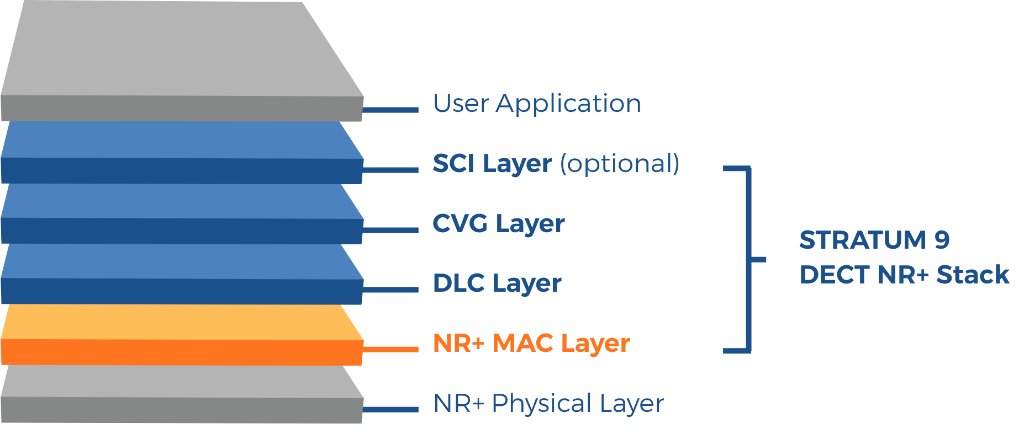
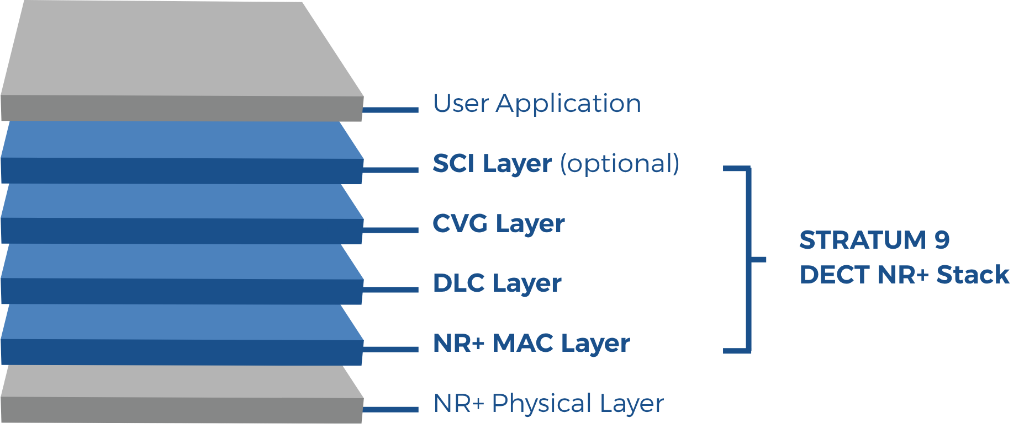
The DECT NR+ Software Stack has a modular design and provides a powerful foundation for industrial wireless solutions. It is based on the NR+ physical layer from Nordic Semiconductor, on top of which the NR+ MAC layer, the DLC layer, the CVG layer and (optionally) the SCI layer are built. Above this runs the user application, which makes the stack’s functions available for specific applications. This creates a flexible architecture in which each layer performs clearly defined tasks and interacts optimally with the others.
Functions
Discover the various functions and roles of the individual layers in our DECT NR+ Software Stack.
Der PHY Layer (Physical Layer) bildet die Grundlage der Kommunikation. Hier werden digitale Informationen in physikalische Signale umgewandelt und über das jeweilige Medium, etwa Funk oder Kabel, übertragen. Er legt fest, wie Bits moduliert werden, auf welcher Frequenz sie gesendet werden und wie die Signalstärke geregelt wird.
In DECT NR+, OFDM with cyclic prefix is used. This is a modern and highly efficient modulation method that is also applied in advanced wireless communication systems. By distributing data across many narrowband subcarriers and adding a cyclic prefix, transmission becomes significantly more robust against multipath propagation, meaning reflected signals or echoes. As a result, interference caused by delayed signal components can be greatly reduced.
In short, the PHY layer enables communication at the physical level and, through modern methods such as OFDM with cyclic prefix, helps ensure robust and reliable wireless transmission.
The STRATUM 9 MAC layer (Media Access Control Layer) provides structure and control. It regulates access to the medium, allocates transmission slots and prevents collisions (determining who is allowed to transmit and when). In industrial environments in particular, this layer is essential for predictable latency, coordinated communication and deterministic system behaviour.
The DLC layer (Data Link Control Layer) ensures reliable data exchange. It formats and packages information into structured packets and guarantees their integrity during transmission. This transforms simple connectivity into reliable communication that applications can depend on.
Depending on user requirements for latency, reliability and data volume, the DLC layer offers various service types:
Service Type 0: Transparent Mode (DLC-T) Ultra-fast point-to-point connections with no overhead, ideal for time-critical control signals
Service Type 1: Segmentation Mode (DLC-S) Transmission of larger data blocks (e.g. sensor data) with guaranteed ordering
Service Type 2: DLC ARQ Mode (DLC-A) Reliable transfer with retransmission support
Service Type 3: Segmentation & ARQ Mode (DLC-SA) Reliable delivery of large data sets (e.g. firmware updates) over lossy links
The CVG Layer (Convergence Layer) acts as the bridge between the communication functions of the lower layers and the requirements of the higher-level layers. It consolidates relevant information from the stack, abstracts technical details, and provides applications with a consistent interface for further processing.
The SCI Layer (STRATUM 9 Controller Interface Layer) acts as the interface between the software stack and the outside world. It enables the connection of controllers, applications and tools, coordinates commands and distributes relevant information within the system. In this way, it not only simplifies integration into different environments, but also supports efficient operation as well as service and diagnostic functions.
For the transparent, unmodified transmission of industrial Ethernet and fieldbus protocols such as PROFINET, an additional Network Layer can be implemented alongside the SCI Layer, enabling Ethernet over DECT NR+.
This is the layer in which the customer’s application is implemented, making the stack’s functions available for specific use cases.
Our DECT NR+ Stack Services
Software Stack
Stack as a Zephyr module for integration into your firmware project
Zephyr Module
Integrate our DECT NR+ stack directly into your nRF91 firmware project as a Zephyr module.
Software Development Kit
Develop your DECT-NR+ application faster and more efficiently - with our powerful SDK.
Add-on Module
More functions, less effort: our add-on modules relieve you of the burden of implementation and create space for your core applications.
Firmware Image
Firmware for the nRF9161 / nRF9151
Out of the box package
Ready-to-use firmware image with all basic functions for immediate use of DECT-NR+ on your hardware.
nRF91 as a ready-to-use communication module
By using our tried and tested firmware image, you save yourself the trouble of developing your own firmware for the nRF91 chip.
Own application controller
Your application runs on a controller of your choice and communicates with the nRF91 via defined interfaces.
Development Package
Development of hardware, firmware and backend services...
Hardware development
We develop customized hardware solutions - from the idea to the product ready for series production.
Firmware development
Our firmware is customized precisely to your hardware and application, ensuring smooth, high-performance processes.
Back-End Services
With our scalable backend solutions, you retain control of your devices and data at all times - securely, centrally and intelligently analysed.
Scheduled Access vs. Random Access
DECT NR+ supports two fundamentally different approaches regarding channel access. Understanding the difference is crucial for selecting the right solution for your application.
Scheduled Access
Scheduled Access uses Time Division Multiple Access (TDMA), where the base station (Fixed Termination Point) centrally assigns dedicated, recurring time slots to each device. There are no conflicts, no listening, no back-off – each device knows exactly when it can transmit. This leads to a deterministic, collision-free communication with guaranteed latency.
The STRATUM 9 MAC layer has been specifically designed for industrial automation: AGV fleet control, real-time PLC communication, robot coordination, and all scenarios where predictable timing is not optional but essential. It enables reliable, deterministic communication with clearly defined transmission behavior, even in demanding and highly dynamic industrial environments.
Random Access
The star topology with Random Access is ideal for applications such as smart meters, sensor monitoring, and consumer IoT, where absolute time guarantees are less important than simplicityand broad device compatibility.
Tell us about your interest or your use case - we will support you with the integration of DECT NR+.
Contact:
+43 5372 23699 10
office@stratum9.at