DECT NR+ Gateway
Your Gateway to DECT NR+
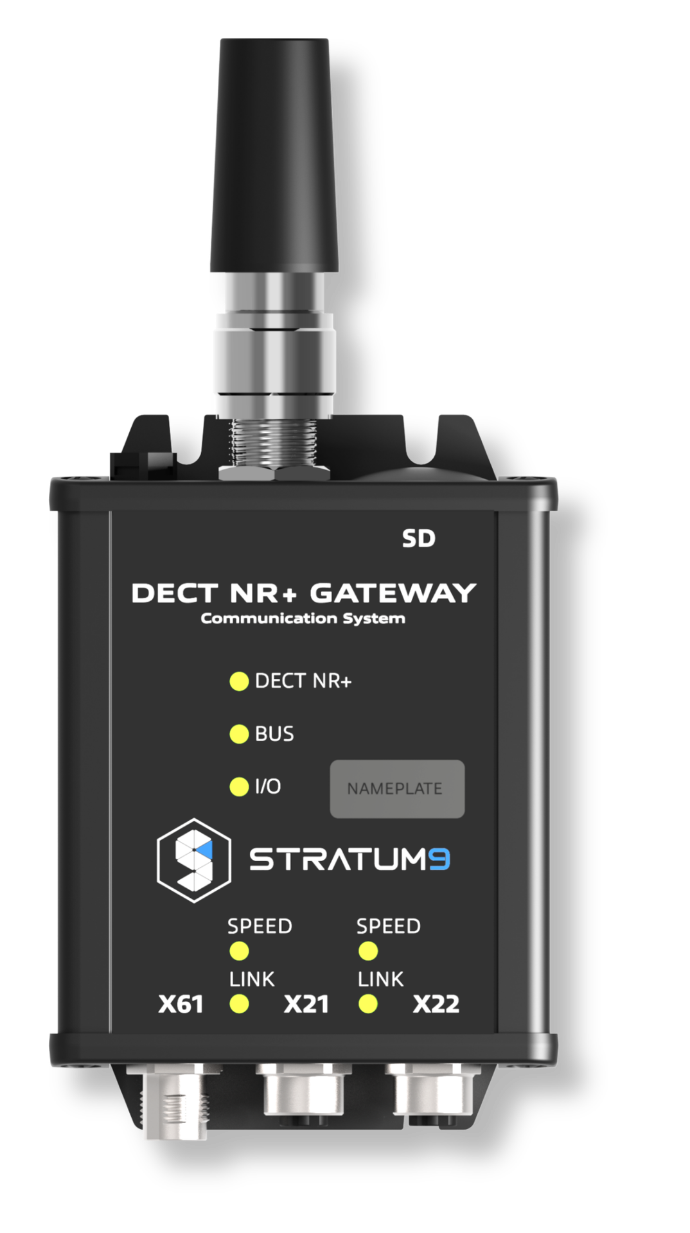
Industrial-grade DECT NR+ hardware that connects deterministic wireless communication to your existing infrastructure – autonomous, scalable, network operator-independent.

Low latency
1.9 GHz DECT NR+
Flexible integration
White-label ready
FLEXIBLE INTEGRATION
Dual-Role-Device
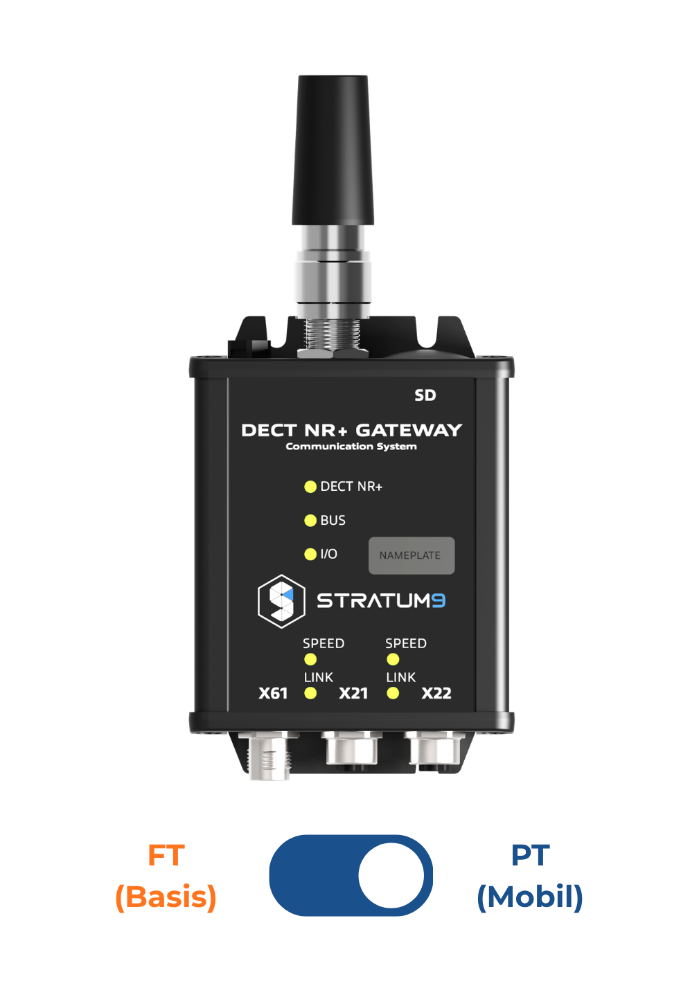
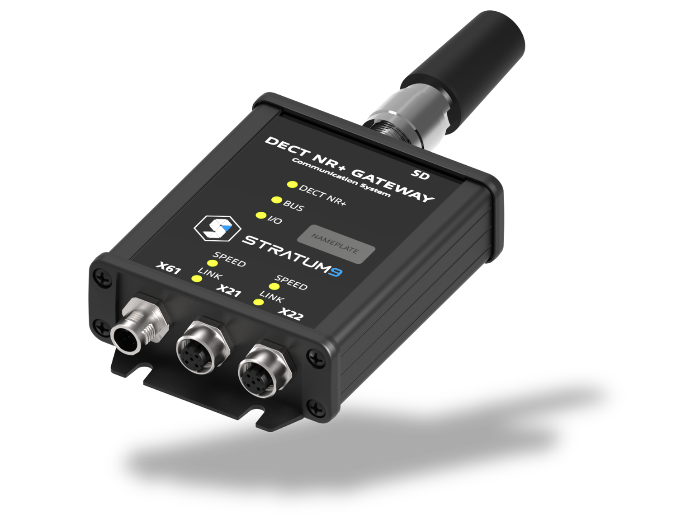
Easily configure the DECT NR+ Gateway as a Fixed Termination Point (FT) for use as a base station, or as a Portable Termination Point (PT) for mobile participants. The same DECT NR+ hardware can serve either as the fixed infrastructure or as a mobile unit, simplifying system design, implementation and maintenance.
FLEXIBLE INTEGRATION
Dual-Role-Device
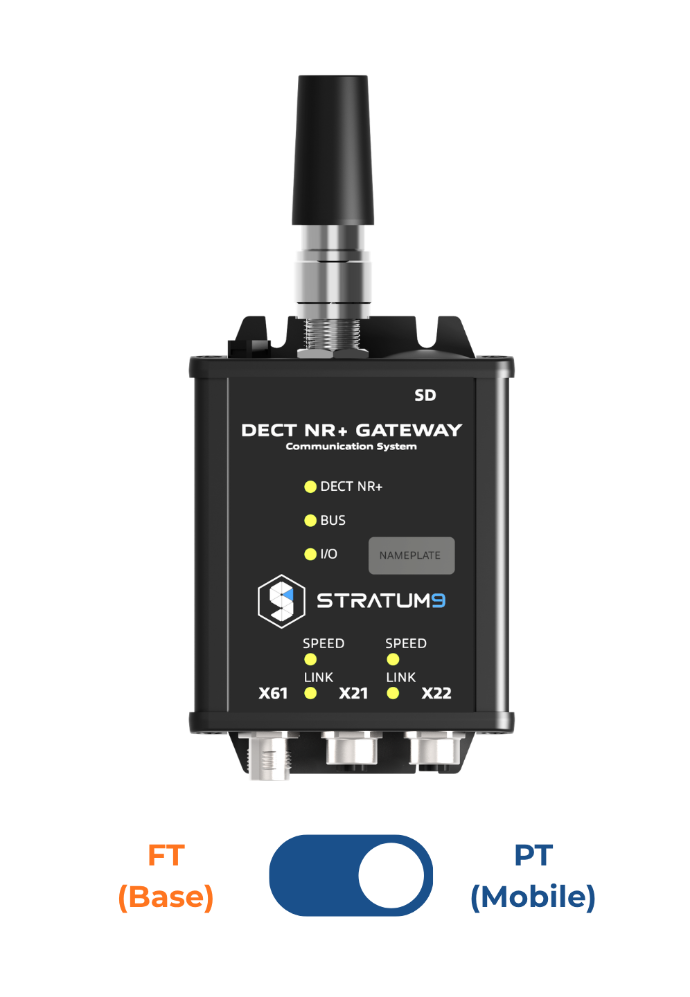
Easily configure the DECT NR+ Gateway as a Fixed Termination Point (FT) for use as a base station, or as a Portable Termination Point (PT) for mobile participants. The same DECT NR+ hardware can serve either as the fixed infrastructure or as a mobile unit, simplifying system design, implementation and maintenance.
UNIQUE TECHNOLOGY:
Deterministic Communication
Thanks to the integrated STRATUM 9 MAC layer, the DECT NR+ Gateway enables deterministic transmission slots and predictable low latency. Each mobile device is allocated fixed time slots, thereby reliably preventing collisions and unpredictable delays. This makes the gateway ideal for time-critical applications such as the control of mobile units or safety-critical signal transmission.
This technology also allows devices to remain in power-saving mode until the scheduled transmission time, making it ideal for battery-powered sensors and actuators.
APPLICATION AREA:
Industrial Real-Time Communication
Communication: Star Topology
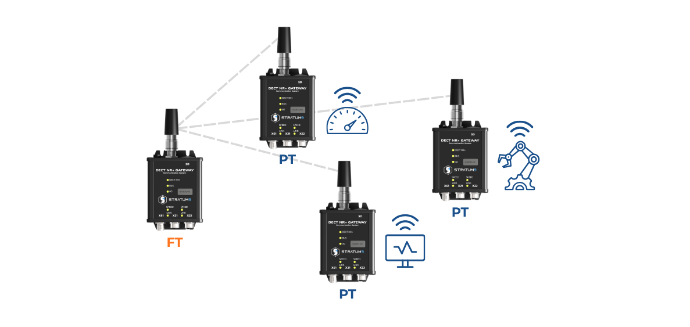
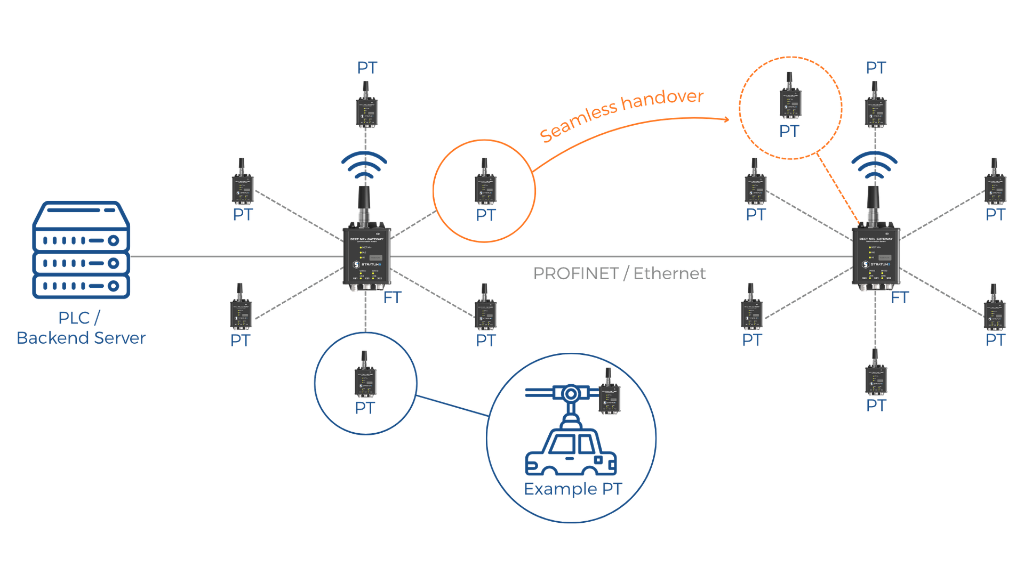
Stationary DECT NR+ Gateways act as base stations (Fixed Termination Points (FT)), whilst mobile DECT NR+ Gateways – mounted on AGVs, robots or mobile platforms – operate as Portable Termination Points (PT). The hardware is exactly the same, just configured differently.
The STRATUM 9 Scheduled Access MAC Layer allocates deterministic time slots to each mobile gateway. As they move between base stations, ‘seamless handover’ between the base stations ensures an uninterrupted and loss-free communication flow.
The challenge
How DECT NR+ solves the problem
DECT NR+ enables reliable point-to-multipoint communication between a central radio station and numerous mobile units throughout the facility. Thanks to the dedicated frequency band, deterministic communication mechanisms and high robustness in industrial environments, position data, statuses and control information can be transmitted reliably and with predictable behaviour.
INDUSTRIAL REAL-TIME COMMUNICATION:
KEY FEATURES
Wireless PROFINET / PROFIsafe
The DECT NR+ Gateway combines wireless deterministic communication with transparent PROFINET and PROFIsafe transmission for mobile applications. It transmits PROFINET and PROFIsafe without any modification, protocol conversion or manipulation, and without the need for additional interfaces.
Communication remains fully transparent, requiring no changes to the PLC or the application. As a result, the existing infrastructure stays lean and clearly structured, system complexity is reduced, and retrofit projects, for example, can be implemented in existing installations during ongoing operation, without downtime.
Seamless Handover
In industrial environments, unstable communication can trigger costly emergency shutdowns. The DECT NR+ Gateway enables seamless handover as mobile units move between base stations, ensuring a constant connection without communication dropouts or unnecessary downtime – even in high-speed or constantly moving applications. This results in a reliable industrial wireless connection that is ideal for applications involving mobile robots, electric monorail systems or rotating machinery.
Application Use Cases:
The challenge
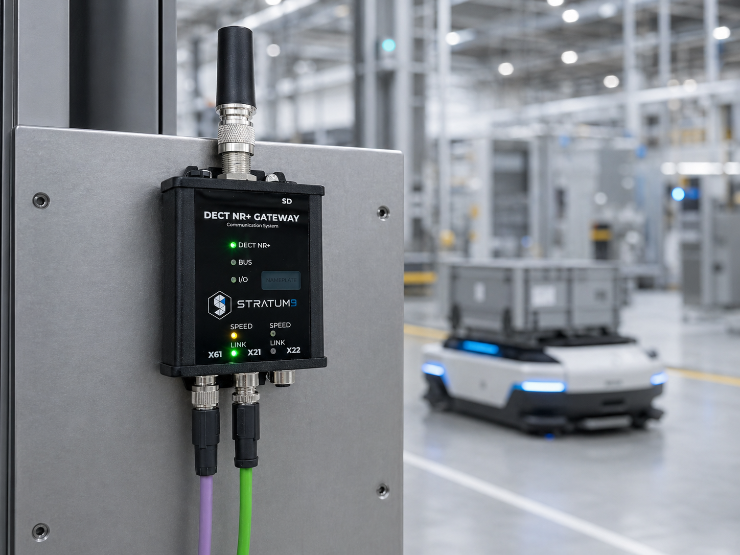
Over 40 driverless transport vehicles are in use in a large warehouse, requiring continuous, deterministic communication for navigation and collision avoidance. The use of Wi-Fi causes unpredictable latency spikes, leading to emergency stops.
How DECT NR+ solves the problem
Stationary DECT NR+ gateways serve as base stations throughout the facility, while each AGV carries a mobile DECT NR+ gateway as a communication endpoint. STRATUM 9's Scheduled Access MAC Layer provides each mobile gateway with dedicated time slots, ensuring deterministic latency. Seamless handover between stationary gateways ensures uninterrupted control while the AGVs travel through the warehouse.
The challenge
A flexible manufacturing cell uses mobile robots that move between workstations. The robots must be coordinated with the central PLC in real time, but the Wi-Fi connection causes problems that disrupt synchronisation.
How DECT NR+ solves the problem
Each mobile robot is equipped with a mobile DECT NR+ gateway that communicates with stationary DECT NR+ gateways installed throughout the manufacturing cell. The point-to-multipoint topology with seamless handover between stationary gateways ensures continuous communication during robot movement. The Scheduled Access protocol ensures collision-free transmission between all mobile and stationary gateways, enabling uninterrupted real-time PLC integration.
The challenge
How DECT NR+ solves the problem
DECT NR+ ermöglicht eine zuverlässige Punkt-zu-Mehrpunkt-Verbindung zwischen einer zentralen Funkstation und vielen mobilen Einheiten entlang der Anlage. Durch das dedizierte Frequenzband, deterministische Kommunikationsmechanismen und die hohe Robustheit in industriellen Umgebungen lassen sich Positionsdaten, Zustände und Steuerinformationen stabil und mit vorhersehbarem Verhalten übertragen.
APPLICATION AREA:
Industrial Data Transmission
Communication: Star Topology
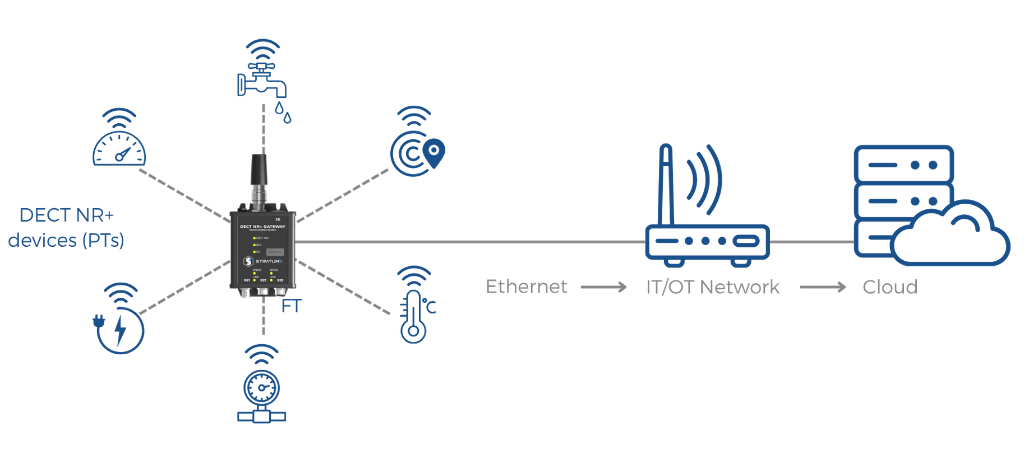
The DECT NR+ Gateway serves as a central access point for all DECT NR+ devices that need to send data to the network. It connects DECT NR+ to Ethernet – compatible with both the ‘Scheduled Access’-based STRATUM 9 MAC layer and the ‘Random Access’-based Nordic Semiconductor MAC layer.
The deterministic STRATUM 9 MAC layer enables devices to remain in power-saving mode until the scheduled transmission time. In this configuration, the gateway is ideally suited for battery-powered sensors and actuators.
The challenge
How DECT NR+ solves the problem
The S9 DECT NR+ Gateway enables OEMs to use a proven Ethernet bridge for their own DECT NR+ products. Instead of investing in parallel gateway development, they can leverage an existing infrastructure component that connects their devices to the customer's network and backend systems, reducing effort, risk and time to market.
INDUSTRIAL DATA TRANSMISSION:
KEY FEATURES
Energy-Efficient Operation
The DECT NR+ Gateway combines deterministic wireless communication with energy-efficient operation for battery-powered sensors and actuators. The STRATUM 9 MAC layer precisely schedules the transmission times of the connected DECT NR+ devices. This allows the devices to remain in power-saving mode until the scheduled transmission or reception time and only become active when communication is actually required. This significantly reduces energy consumption, extends battery life and enables low-maintenance wireless applications even in locations where a permanent power supply is unavailable or can only be provided at considerable expense.
Integrated IPv4 NAT Routing
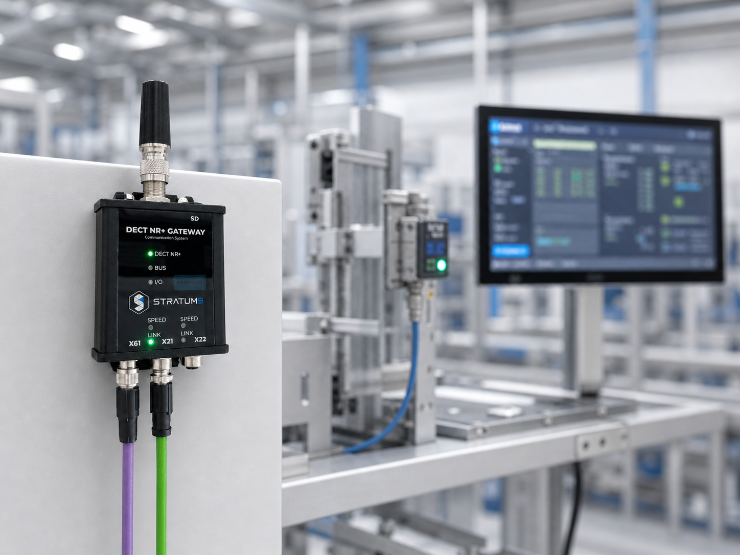
The gateway connects the DECT NR+ wireless network directly to a local LAN, enabling IP-based communication with connected systems and applications. Integrated IPv4 NAT routing allows DECT NR+ devices to be seamlessly integrated into existing IT and IoT infrastructures. The gateway handles the mediation between wireless communication and the higher-level IP network, without the need for additional routers or protocol converters. This keeps the network infrastructure lean and clearly structured, while data is transmitted directly via standardised IP-based communication paths.
Application Use Cases:
The challenge
A large industrial site operates thousands of wireless measurement points throughout its facility. Each device uses DECT NR+ (with Nordic MAC Layer) for communication, but the collected data still needs to be transferred to the central monitoring and analysis platform via the existing corporate network.
How DECT NR+ solves the problem
STRATUM 9 DECT NR+ gateways form the interface between DECT NR+ and Ethernet. They collect data from all devices within range and transmit it reliably to the network. Thanks to their support for the Nordic MAC layer, they are also compatible with standard DECT NR+ devices.
The challenge
An existing factory wants to equip older machines with wireless vibration sensors for predictive maintenance. The sensors use DECT NR+ for communication, but the factory's SCADA system only accepts data sources connected via Ethernet.
How DECT NR+ solves the problem
The STRATUM 9 DECT NR+ gateway transmits the DECT NR+ sensor data directly to the factory's Ethernet network. The SCADA system recognises the gateway as a standard network device, so no changes to the existing infrastructure are necessary. The STRATUM 9 toolchain handles the configuration and monitoring of the entire deployment.
The challenge
How DECT NR+ solves the problem
The STRATUM 9 DECT NR+ Gateway enables OEMs to use a proven Ethernet bridge for their own DECT NR+ products. Instead of investing in parallel gateway development, they can leverage an existing infrastructure component that connects their devices to the customer's network and backend systems, reducing effort, risk and time to market.
INTEGRATION
One Device.
Unlimited Possibilities.
With its compact, modular design and flexible configuration options, our DECT NR+ Gateway adapts to your specific application architecture.
FT or PT?
The gateway is a ‘dual-role device’: the same hardware can be configured as a base station (Fixed Termination Point/FT) or as a mobile unit (Portable Termination Point/PT), which simplifies system design, implementation and maintenance.
Scheduled or Random?
The DECT NR+ Gateway supports both the STRATUM 9 Scheduled Access MAC layer for predictable, deterministic communication and the Nordic Random Access MAC layer for a wide range of non-time-critical DECT NR+ applications.
Seamless Integration
The gateway is optimised for industrial environments and enables seamless integration via Ethernet and CAN interfaces, while M12 and N-type connectors ensure vibration-resistant connections.
Need More Bandwidth?
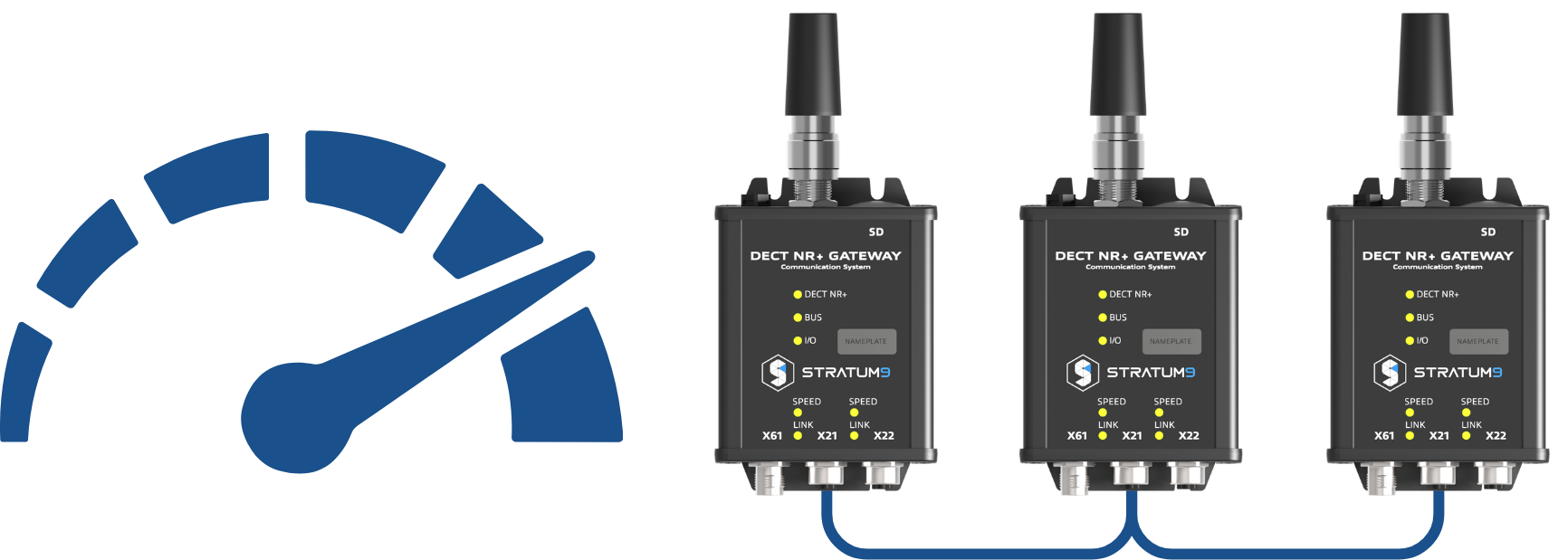
The DECT NR+ Gateway offers a device stacking function that combines multiple FTs into a “Super FT” with higher bandwidth when your data load or number of connected devices increases.
Technical Data
Industrial quality
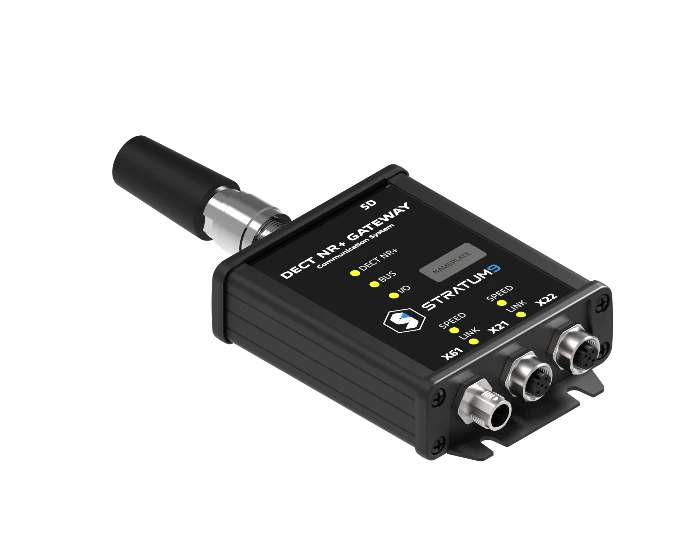
Each component of the DECT NR+ gateway has been selected for its reliability in demanding environments. The aluminium housing ensures robust mechanical design and high protection in industrial use, while M12 and N connectors guarantee vibration-proof connections.
Connections and interfaces
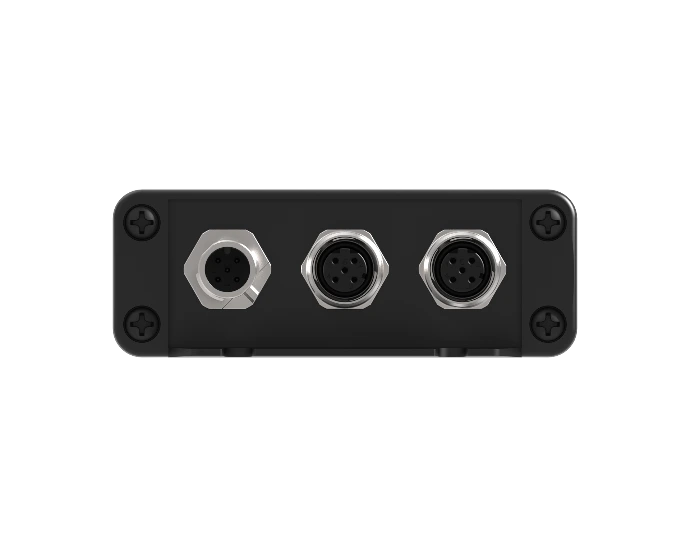
Three M12 connectors on the front: one M12 connector with A-coding for the 24 V DC power supply & CAN and two M12 connectors with D-coding for redundant network connectivity or daisy chaining.
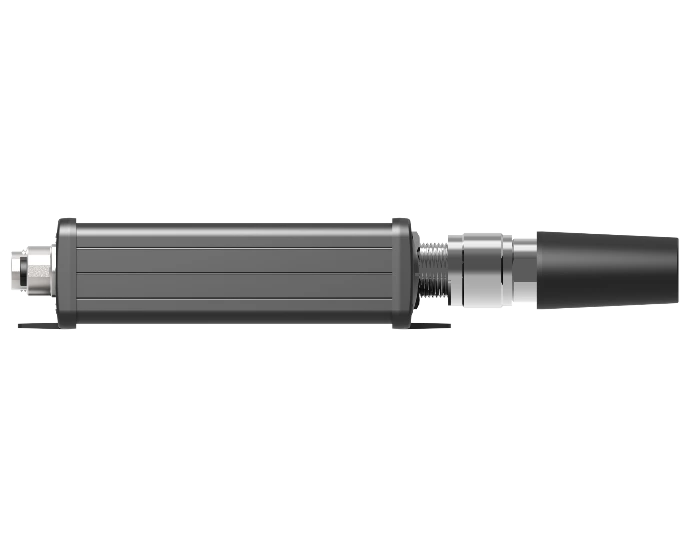
Antenna & RF
External DECT NR+ antenna with N connector for optimal coverage. The dedicated 1.9 GHz spectrum ensures virtually interference-free operation even in the most demanding RF environments.
Reliable Connectivity
Every application is different. Our DECT NR+ Gateway adapts to your infrastructure, whether you need reliable real-time communication for mobile applications or a wireless Ethernet bridge for sensor-based data transmission. The gateway hardware integrates seamlessly into existing network structures, enabling fast implementation with minimal effort.
Speak to our engineering team to find the right configuration for your application.

Tell us about your interest or your use case - we will support you with the integration of DECT NR+.
Contact:
+43 5372 23699 10
office@stratum9.at