
Industrial systems are required to become more flexible, more modular and faster to reconfigure. At the same time, PROFINET remains the central communication backbone in many machines and plants, supporting cyclic I/O data, diagnostics, alarms and the integration of intelligent field devices.
In practice, this creates a clear conflict of objectives: communication must remain robust, predictable and real-time capable, but without additional cabling effort, mechanically vulnerable drag chains or rigid plant structures.
This is exactly where STRATUM 9 comes in with PROFINET over DECT NR+. For us, the objective is not to replace an existing automation model but to modernise the transmission path so that PROFINET can also be used reliably wherever cables reach their practical and economic limits.
The decisive point is not simply “wireless”, but deterministic. For industrial communication, it is not enough for data to arrive at some point. What matters is that data is transmitted predictably, reproducibly and transparently, even when devices are moving or plant structures change. DECT NR+ (DECT-2020 NR) addresses precisely these kinds of local, reliable and low-latency wireless networks.

What is PROFINET?
PROFINET, short for Process Field Network, is an open Industrial Ethernet standard from PROFIBUS & PROFINET International (PI). In industrial automation, PROFINET serves as the communication basis between controllers, field devices and higher-level systems. Today, it is widely established in mechanical engineering, manufacturing and process industries.
Unlike classic fieldbus systems, PROFINET is based entirely on Ethernet. This makes it possible to combine standard IT communication and industrial real-time communication within a shared network architecture. That is exactly what makes PROFINET so powerful in practice: the standard combines openness, broad availability and end-to-end integration with the requirements of industrial automation.
The starting point: PROFINET is established, but plants are becoming more mobile
In industrial practice, PROFINET is already firmly established. Controllers, remote I/O, drives, vision systems, RFID, diagnostic functions and safety components in many machines and production lines are designed around it. At the same time, requirements are changing significantly:
- Machine modules need to be added or repositioned flexibly.
- AGVs, AMRs and other mobile participants need to be integrated cleanly into automation systems.
- Rotating or moving plant components create wear, cost and downtime risks when cables, drag chains and slip rings are used.
- Brownfield plants need to be modernised without rebuilding the entire infrastructure.
The real question is therefore not simply: how do we bring wireless communication into the plant?
The more important question is: how do we transport PROFINET in a way that remains industrially robust?
This is exactly where many wireless approaches fail. What is sufficient for office networks or simple telemetry is far from suitable for cyclic automation. In industrial environments, maximum values from a data sheet are not what count. What matters are reproducible latencies, stable communication paths, controlled behaviour during mobility and an architecture that integrates predictably into PLC and I/O environments.
Why determinism is the real core of the topic
When people talk about wireless industrial communication, they often start with range or bandwidth. For PROFINET, however, something else is decisive: determinism.
In this context, deterministic communication means that transmission behaviour, latency and channel access are predictable. This is the prerequisite for cyclic communication, diagnostics and alarm handling to function reliably in real industrial environments.
This is where DECT NR+ becomes particularly interesting. It not only supports low latencies, but also provides mechanisms that allow communication to be operated in a much more controlled and predictable way than with conventional contention-based wireless methods.
For us, this is the decisive difference: we do not see wireless communication as a best-effort medium, but as a predictable transport layer for industrial communication.
Why DECT NR+ is such a strong technical fit for PROFINET
DECT NR+ offers ideal conditions for industrial wireless applications. The standard uses the dedicated, licence-exempt 1.9 GHz band, enabling particularly robust and interference-resistant communication. Unlike WLAN, DECT NR+ is based on Scheduled Access (TDMA), creating the foundation for deterministic data transmission.
This is what creates the technical fit with PROFINET:
- The PLC remains in its familiar PROFINET environment.
- Field devices remain within the established engineering and diagnostics model.
- The wireless link provides the planned and robust data path.
- Mobility is not treated as an exception, but is considered in the architecture from the outset.
Our approach at STRATUM 9: transparent, deterministic, mobile
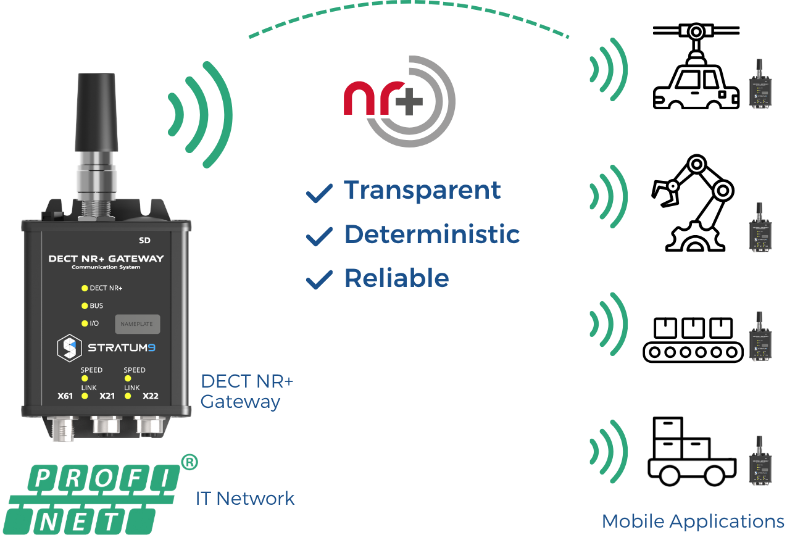
For us, PROFINET over DECT NR+ is only suitable for industrial use if three things are achieved at the same time: full transparency, true determinism and stable mobility.
Full transparency means that PROFINET is transmitted wirelessly without being modified. No protocol conversion, no additional interfaces, no intervention in the communication. For the PLC and the application, PROFINET remains exactly what it should be: PROFINET. This keeps existing architectures stable, reduces complexity and significantly simplifies the integration of moving or remote participants.
True determinism means no random access mechanisms, no uncontrollable latency peaks and no best-effort behaviour. Instead, we work with Scheduled Access and fixed time slots. Unlike WLAN, devices do not compete for airtime. They transmit in defined slots. This enables collision-free, predictable communication with consistently low latency and creates the basis for industrial real-time communication over wireless.
Stable mobility means that communication must not break down simply because a participant is moving. That is why Seamless Handover is a central component of our approach, enabling uninterrupted transitions between radio cells so that the connection remains constant even in fast or continuously mobile applications. Communication losses are avoided and unnecessary downtime is reduced. The result is a robust wireless infrastructure for industrial applications such as mobile robots, electric monorail systems or rotating plant components.
This combination creates the real added value of our technology: transparent PROFINET and PROFIsafe transmission, deterministic communication and Seamless Handover in a single wireless architecture.
How we implement PROFINET over DECT NR+ in practice
The practical architecture is deliberately clear.
- On the fixed plant side, the existing PROFINET network remains in place.
- At the handover point, we bring the Ethernet-based traffic onto the DECT NR+ wireless link.
- On the mobile or remote side, we provide the connection again as an Ethernet segment for the PROFINET participants.
- The wireless link is not treated as a generic IT connection. It is designed according to load profile, communication behaviour, mobility requirements and reserve capacity.
A central building block for this is our DECT NR+ Gateway, a powerful radio unit developed specifically for industrial DECT NR+ applications. With uniform hardware for stationary and mobile communication interfaces, we create the infrastructure foundation for integrating industrial communication wirelessly into existing Ethernet architectures, including PROFINET-related environments.
Where PROFINET over DECT NR+ is particularly useful
The approach is especially strong wherever cables are mechanically disadvantageous, maintenance-intensive or structurally impractical:
- AGVs and AMRs in intralogistics and manufacturing
- Rotating or moving machine components
- Modular machines and flexible production cells
- Brownfield retrofits with high cabling effort
- Temporary production setups or rapidly reconfigurable lines
- Remote I/O connections in hard-to-access plant areas
In these scenarios, the aim is not simply to eliminate cables. The aim is to create greater degrees of freedom in machine and plant engineering without sacrificing automation communication quality.
Conclusion
For us, PROFINET over DECT NR+ is a logical response to real industrial requirements: greater mobility, greater modularity, less mechanical complexity and communication that remains predictable even without cables.
The central advantage does not lie in wireless technology alone, but in determinism. Only when PROFINET can be transmitted transparently, reproducibly and with mobility support does wireless communication become a serious industrial architecture.
With our DECT NR+ Gateway, this approach becomes practically implementable: as an infrastructure building block for transparent, deterministic PROFINET transmission with Seamless Handover in real industrial applications.