
In modern industrial environments, the focus is increasingly shifting from conventional automation towards highly connected, flexible and mobile systems. Machines, sensors, automated guided vehicles and controllers must communicate with one another in real time, reliably, synchronously and, above all, predictably.
This is where one concept becomes central: deterministic communication.
What does deterministic mean?
Deterministic communication describes a network’s ability to transmit data within a defined and guaranteed time frame. It is not simply about data arriving “quickly”, but about data arriving at precisely the right time, every time.
- A controller knows exactly when a sensor value will arrive.
- An actuator responds within a clearly defined time window.
- The maximum latency is known and never exceeds a defined limit.
The key difference compared with traditional IT networks is not average performance, but predictability. For industrial processes, this predictability is essential, as it directly affects the stability of control loops and the quality of production processes.
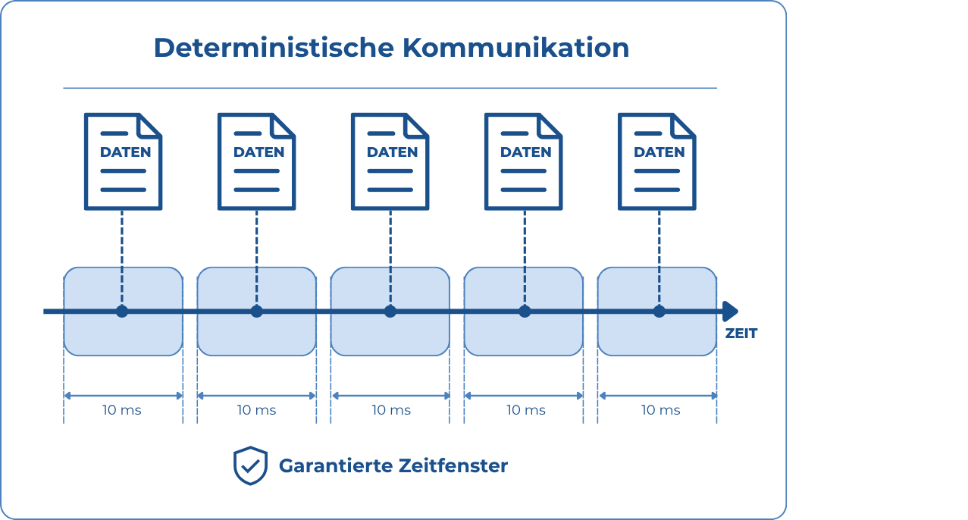
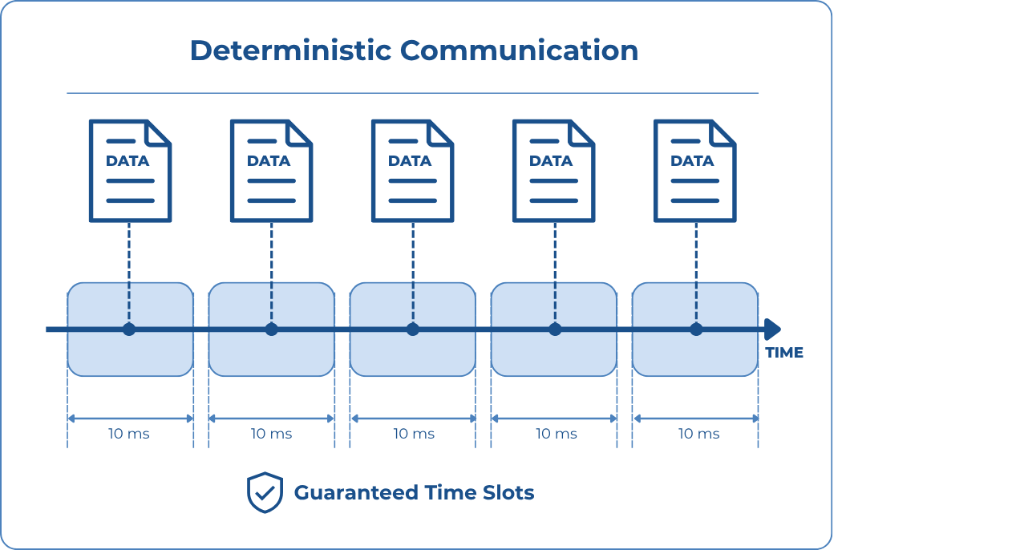
Industrial processes require predictable communication with guaranteed transmissions within defined time windows.
Why conventional Wi-Fi is often not enough
Many industrial applications still rely on Wi-Fi today because it is widely available, cost-efficient and easy to integrate. Technically, however, Wi-Fi is based on a random access method and uses Listen-Before-Talk, or LBT.
The principle is simple:
Each device decides for itself when it wants to transmit. Before transmitting, it checks whether the medium is free. If several devices attempt to transmit at the same time, collisions can occur and are resolved through random waiting times, known as backoff.
Imagine a polite but unmoderated group discussion. Everyone listens before speaking, but when two people begin at the same time, both pause and wait for a brief, awkward moment before one tries again. In a small group, this works well. In a large crowd, however, it leads to constant interruptions and very little effective communication.
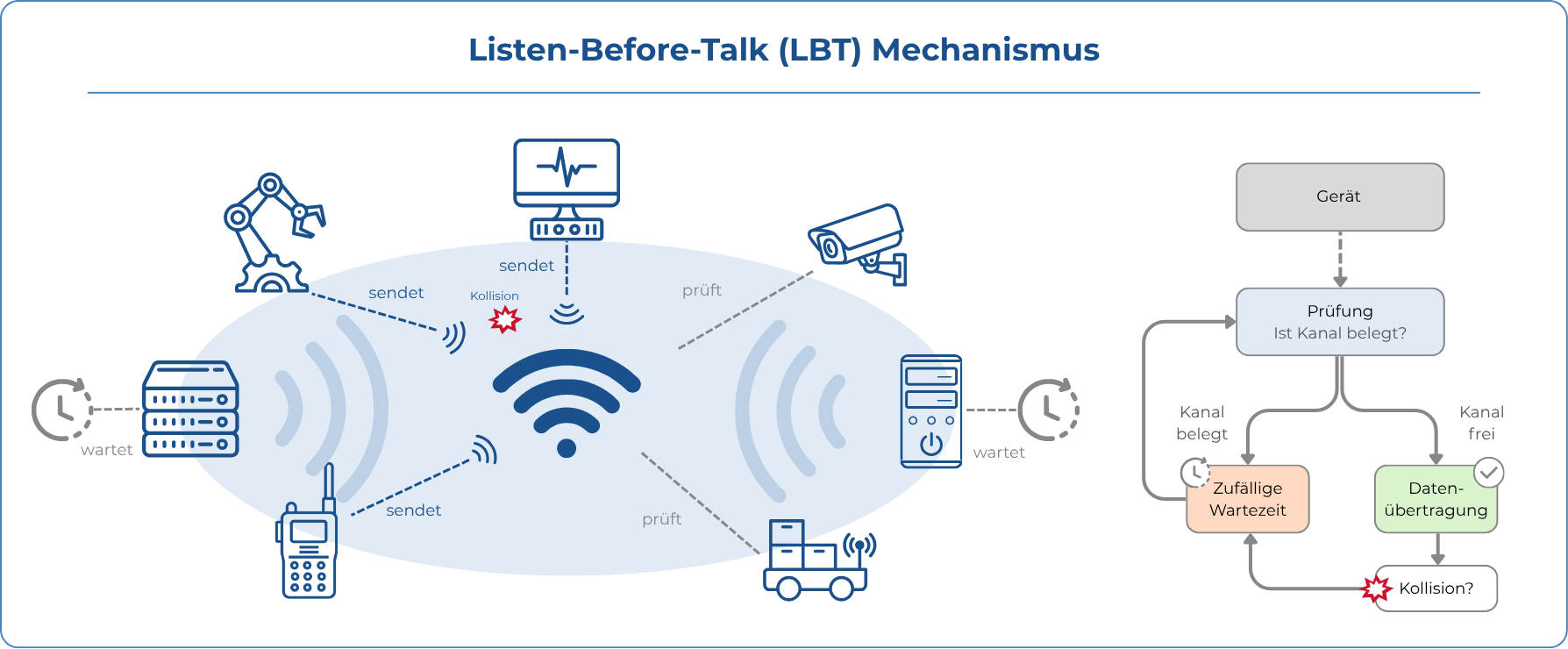
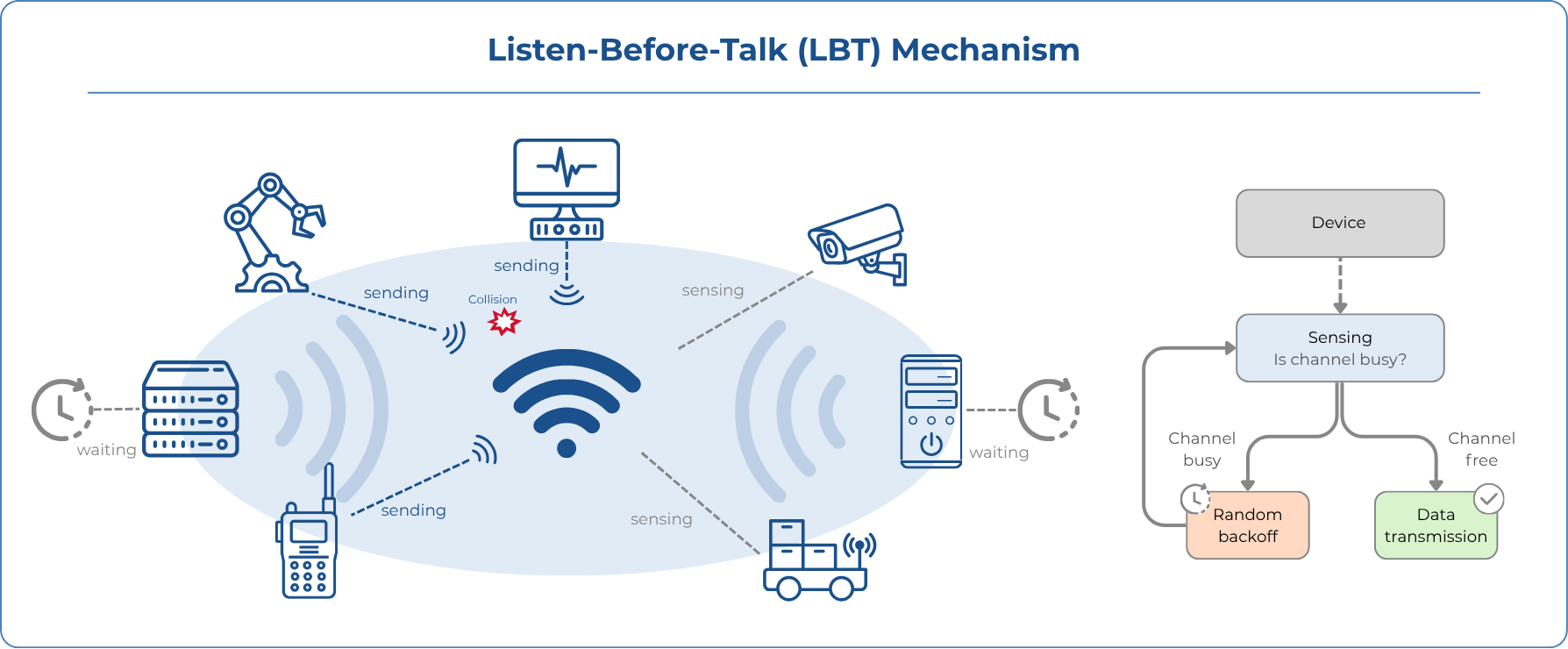
Random Access with Listen-Before-Talk: devices compete for transmission time.
This method works well for typical IT applications such as web access, video streaming or cloud communication.
For industrial applications, however, it creates structural disadvantages:
- Unpredictable latency:
- The time it takes for a device to transmit depends on the current network load and can vary significantly.
- Jitter:
- Even when average latency is low, fluctuations can be high, which is problematic for synchronised processes.
- Scalability issues:
- As the number of devices increases, so does the likelihood of collisions and delays.
- No hard real-time capability:
- There is no guarantee that a message will be transmitted within a specific time frame.
Wi-Fi is a powerful technology, but it is not deterministic. For many industrial applications, this is a fundamental limitation.
Scheduled access vs. random access
The key difference between conventional wireless technologies and deterministic systems lies in how access to the transmission medium is controlled.
Random Access: the principle behind Wi-Fi
With Random Access, all participants compete for access to the medium. Each node acts independently and responds dynamically to the current network situation. This makes the system flexible and robust in changing traffic conditions, but it has one decisive disadvantage: its behaviour cannot be planned. The more active participants there are, the harder it becomes to predict latency and reliability.
Scheduled Access: the deterministic approach
Deterministic wireless technologies such as DECT NR+ use, among other mechanisms, a different principle. Here, access to the medium is centrally organised. Time is divided into fixed slots, which are assigned to individual devices. Each device knows exactly when it is allowed to transmit, how long it may transmit and when the next slot will occur. This creates a fully controlled system:
- There are no collisions
- Latency is constant and predictable
- Communication follows a fixed schedule
Unlike Random Access, access is not negotiated, it is predefined.
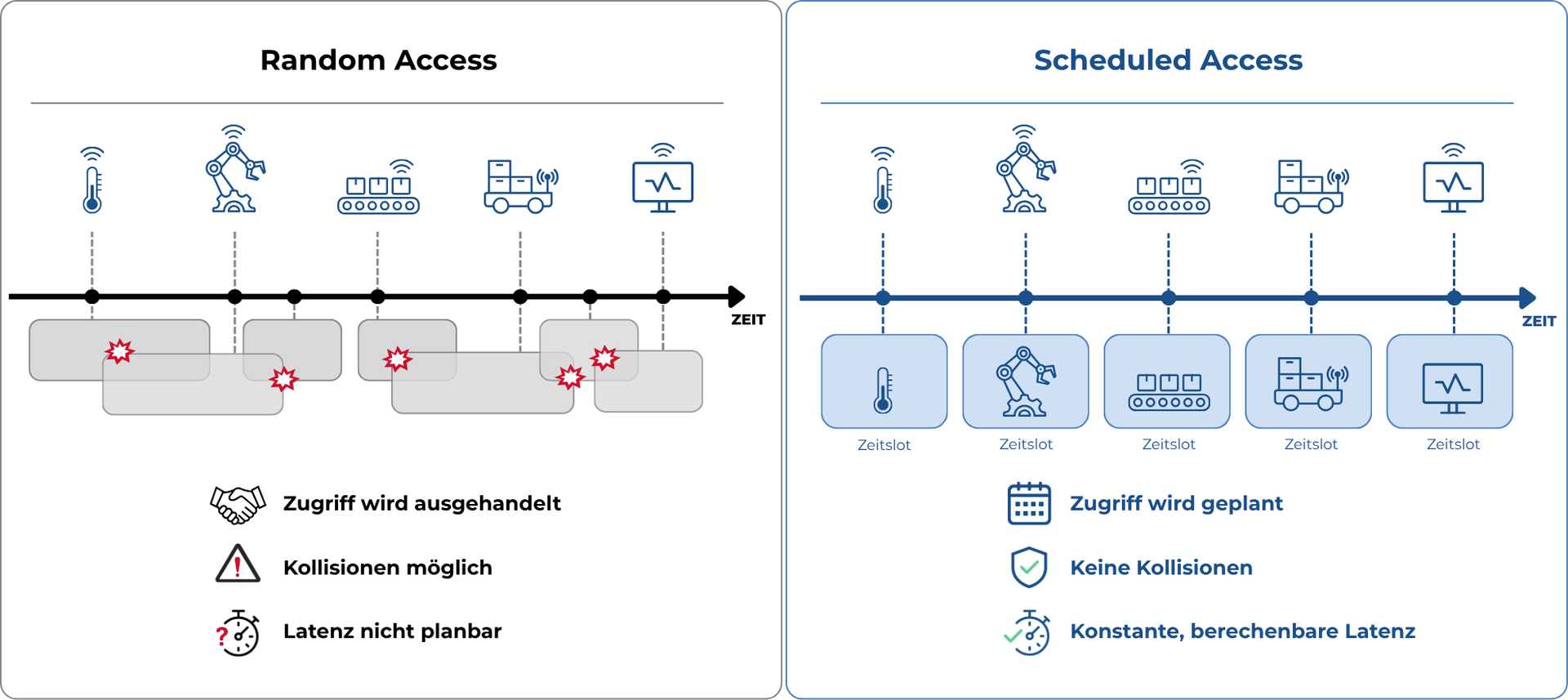
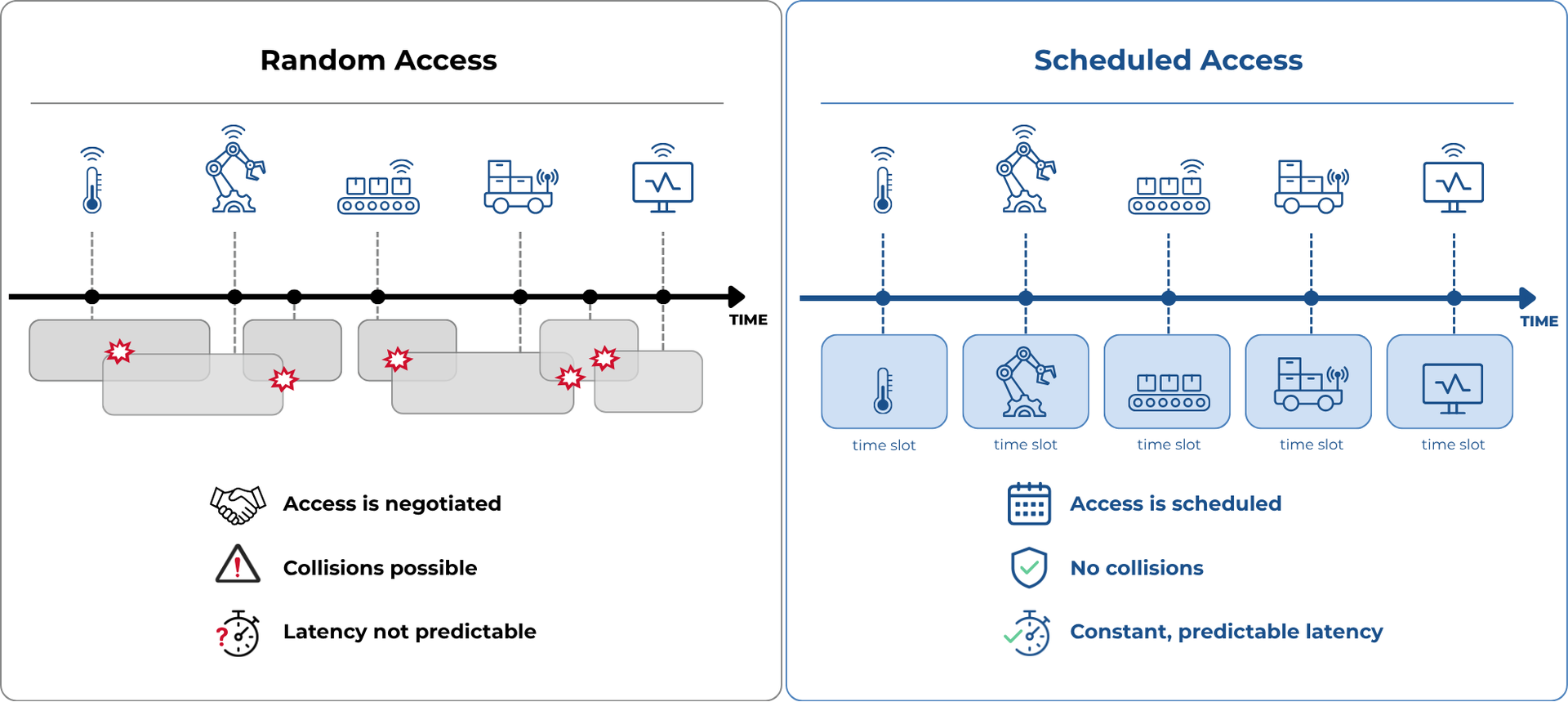
Random Access vs Scheduled Access: the different approaches to accessing the transmission medium.
Why deterministic communication is indispensable in industry
The need for deterministic communication stems directly from the requirements of modern industrial applications.
- Real-time control and synchronisation
In many systems, such as robotics or highly dynamic conveyor systems, processes run in fixed cycles. Sensors provide data, controllers calculate responses and actuators execute them. If communication does not fit precisely into this cycle, inaccurate movements, quality issues, unstable control loops and other problems can occur.
Deterministic communication ensures that all components operate in temporal synchronisation.
- Mobile systems and wireless automation
With the increasing use of AGVs and AMRs, wireless communication is becoming a critical part of control systems. In this context, it is not enough to have a good connection “most of the time”. What is needed instead is stable and continuous communication, predictable response times and reliable transitions between radio cells, known as handover.
In such scenarios, non-deterministic networks can lead to delays, stop-and-go behaviour or, in the worst case, safety-critical situations.
- Functional safety
Safety protocols such as PROFISAFE place high demands on communication. In addition to integrity and availability, timing correctness also plays a central role. A system can only operate safely if it is guaranteed that messages are transmitted within defined time windows and failures can be clearly detected.
Deterministic communication provides the necessary foundation for meeting these requirements reliably.
- Scalability and planning reliability
One often underestimated advantage of deterministic systems is their planning reliability. While Random Access networks become increasingly unpredictable as load rises, a deterministic system remains stable. New participants can be planned into the system in a controlled way without destabilising the behaviour of the overall network. This is particularly important for large production facilities, modular factories and IIoT environments.
DECT NR+ as the foundation for deterministic wireless communication
With DECT NR+, a wireless technology is available that is consistently designed around deterministic industrial requirements.
By combining Scheduled Access, TDMA, centralised resource management, Seamless Handover and high reliability, it creates a wireless system that behaves almost like a wired real-time network, while still offering the flexibility of wireless communication.
For companies, this means more than greater efficiency. It opens up the possibility of fundamentally rethinking production systems: making them more flexible, more mobile and, at the same time, more reliable than ever before.